
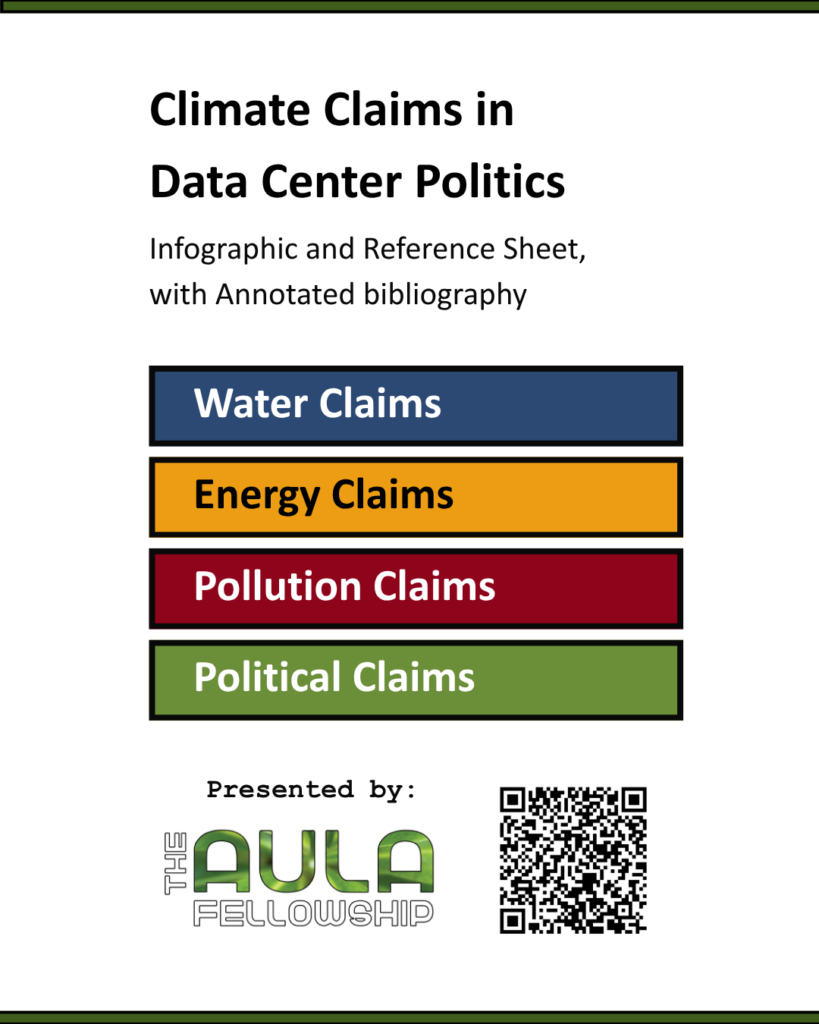
Aula researchers have prepared these resources to provide context, nuance, and evidence to unpack 12 common political claims about data centers.
On this page:
Explore the Infographic
This infographic provides a quick reference to 12 common claims made during discussions on the climate implications of data centers, and the nuance needed for unpacking them. The accompanying annotated bibliography provides citations for further utility.
Get the Infographic:
As a PDF: A 5-page quick reference to the 12 claims and the nuance. Good for sharing by email or online, or printed and handed out. (4 mb, 8.5 x 11″).
For Mobile or Socials: The 12 claims in a card-carousel style suitable for sharing on social media and best viewed on a small screen. (2.7 mb, 1052 x 1350 px).
The annotated bibliography on SSRN: a scholarly report on the logic and evidence in support of the claims and nuances presented in the infographic. The infographic reference number correspond to sections of the annotated bibliography and contain 1 to 4 individual citations each.
View/share/download the infographic (PDF):
View/share/download the infographic (mobile/socials):
Short text
Here are 12 common claims about climate change in data center politics. They cover water, energy, pollution, and community prosperity.
TL&dr:
People need to get informed about climate denialism in data center politics and get involved, because our climate goals are being busted.
Longer:
Have you heard some of these? This infographic by the NGO The Aula Fellowship covers 12 common climate claims in data center politics. If you’re involved in data center policy, investment, or development, you might recognize these claims about the water, energy, pollution, and societal aspects of data center roll-outs in communities. These claims aren’t necessarily wrong, but people can lack the nuance needed for making evidence-based decisions. The infographic and the accompanying annotated bibliography are a resource for improving community-based decision making.
Translations
Languages available are provided by Aula Fellows who are first-language speakers, available for interviews, and who are on the research team for this project or otherwise familiar with the material. If you would like to work on a translation for your community, please get in touch with us by email.
En français: Centres de données et climat : nuancer les affirmations (PDF, 4 mb).
En español: Declaraciones sobre el clima en la política de los centros de datos (PDF, 4 mb).
In het Nederlands: Klimaatclaims in de politiek rond datacenters (PDF, 4 mb).
På norsk: Klimapåstander i datasenterpolitikken (PDF, 4 mb)
N’Igbo: Nkwupụta Ihu Igwe na Ndọrọ Ndọrọ Ọchịchị Ebe Nchekwa Data (PDF, 4 mb)
In addition to these languages, we have a Tamil-speaking co-author available for interviews. See the Notes to the Editor (addendum to the Press Release), for more information on the researchers.
User Guide
How can you use these resources?
These resources are for people who are involved in decisions on data centers. They provide people with resources to understand common claims on climate in data center politics and to respond to them in brief. The infographic is a quick reference, in PDF or Mobile versions. The annotated bibliography further provides in-depth evidence of nuanced information that can materially change decisions and outcomes. City officials, community organizers, journalists, educators and academics, and investors may find these to be of interest.
Consider a quick search online for data centers and data center projects in your area. There are several data center maps available online.
Depending on your specific need, there are different ways you can use these resources, depending on your need.
Elected officials and city planners making data center policy can refer to the evidence when they encounter the claim. The 5-page PDF version can be printed and referred to during meetings. Policymakers should get familiar with the references in the annotated bibliography.
Climate, tech, land use, agriculture, labor organizers working on local justice can prepare for debates in advance for locally-relevant nuance. The 5-page PDF version can be printed and referred to during meetings. The Mobile version can be shared in socials during campaigns. Speakers should get familiar with the references in the annotated bibliography.
Covering tech, climate, local government can fact-check decision makers and provide evidence-based nuance in their reporting. They can use the annotated bibliography for authoritative evidence. See more information in the Press Release and the supplementary Notes to the Editor.
Working in media literacy, climate literacy, tech literacy. For youth to adults. Also scholars and academics in civil engineering, social science / political science. Each may benefit from knowing the claims and being ready to explain or share the nuances with others. The mobile version provides an entry point for educators to use as flash-cards. Academics can get involved with future work.
Investors, advisors, and strategic management specialists can use this information for risk assessment, asset valuation, and strategic planning of construction, land use, data storage planning, supply chain management, product design, and other regional or related concerns. The 5-page PDF version provides a quick reference for print or email, and the annotated bibliography can be of use for due diligence.
Research / Evidence
The purpose of this work is to provide nuance, including debunks, reasoning and fact checking on common climate claims in decision making and public discourse on data centers. Readers may read through the logic for each claim and nuance, provided with references. References have been selected for accuracy, authority, and precision. These references and the chains of reasoning presented constitute a snapshot in time of evidence and nuance. Some claims and nuance pairs – like the idea that water evaporates, then lands in places that put it out of our reach for drinking and farming – are stable over time. Others will evolve over time, like the fact that today we have no nuclear options that are carbon-free nor sufficiently deployable. Nuance is the key to being able to make policies that are fit to intended purposes. Simplifying claims into blanket statements makes them easier to pass into popular use than their nuanced counterparts, but the nuanced ideas work better.
The purpose of this document is to provide nuance, including debunks, reasoning and fact checking on common climate claims in decision making and public discourse on data centers. Readers may read through the logic for each claim and nuance, provided with references. References have been selected for accuracy, authority, and precision. Journalists, civil society organizers, researchers, policymakers, investors, and other interested parties can refer to this annotated bibliography or to the companion infographic. They are distributed under a CC BY-ND license. These references and the chains of reasoning presented constitute a snapshot in time of evidence and nuance. Some claims and nuance pairs – like the idea that water evaporates, then lands in places that put it out of our reach for drinking and farming – are stable over time. Others will evolve over time – like the fact that today we have no nuclear options that are carbon-free nor sufficiently deployable. Nuance is the key to being able to make policies that are fit to intended purposes. Simplifying claims into blanket statements makes them easier to pass into popular use than their nuanced counterparts, but the nuanced ideas work better.
The researchers collected claims about climate effects of data centers from the news, social media, and their work in communities. They then circulated the claims to specialists and in social media and engaged in an iterative process of refining and categorizing the list. The researchers then examined each claim for accuracy and completeness. Claims were often found to be at least partially accurate, but incomplete, leading to misinformation and the potential to promote poor decisions. Evidence of completeness and accuracy were collected from scientific literature, major news media, and company reports. Sources were chosen for being primary or scholarly evidence of the nuances that can correct the initial misinformation. The findings were then summarized into statements for an infographic quick-reference and in an annotated bibliography for more in-depth evidence. The evidence is presented in full on the Social Science Research Network (Mackenzie et al., 2026).
Mackenzie, T., Rajachander, H., Braakman, W., Pelletier, F., Ham, A., and Radeljić, B. (2026). The Aula Fellowship AI Sustainability Council: Annotated Bibliography of Climate Claims in Data Center Politics. Social Science Research Network, August 11, 2026. Available at: dx.doi.org/10.2139/ssrn.7267179
Press Information
Access the Press Release
Access supplementary media information in the Notes to the Editor.
How to Get Involved
Political activities and collective action affect the course of commercial development. For data centers, these activities take place in the economic, democratic, and spiritual spheres of society.
It is a truism that the things we as people choose to build are chosen by individuals who can get to the conversation.
Ways to get involved:
- Research your area. There are several data center maps available online.
- Read petitions and pay attention to online campaigns by rights and tech advocacy organizations.
- Explore toolkits, articles and resources on data center politics and tech information campaigns.
- Get involved in your local community, by communicating with local tech advocacy and climate advocacy groups, or through your employer as a company representative.
- Attend city council meetings and get involved in your local and regional political processes.
Changes, Critiques, and Colleagues
We welcome changes, critiques, and new colleagues. Please use this form or contact us by email at to let us know what you think, what you have found, and what you hope to do about it.
Thank you
Thank you for your interest in engaging on this topic.